The Moment It Happened
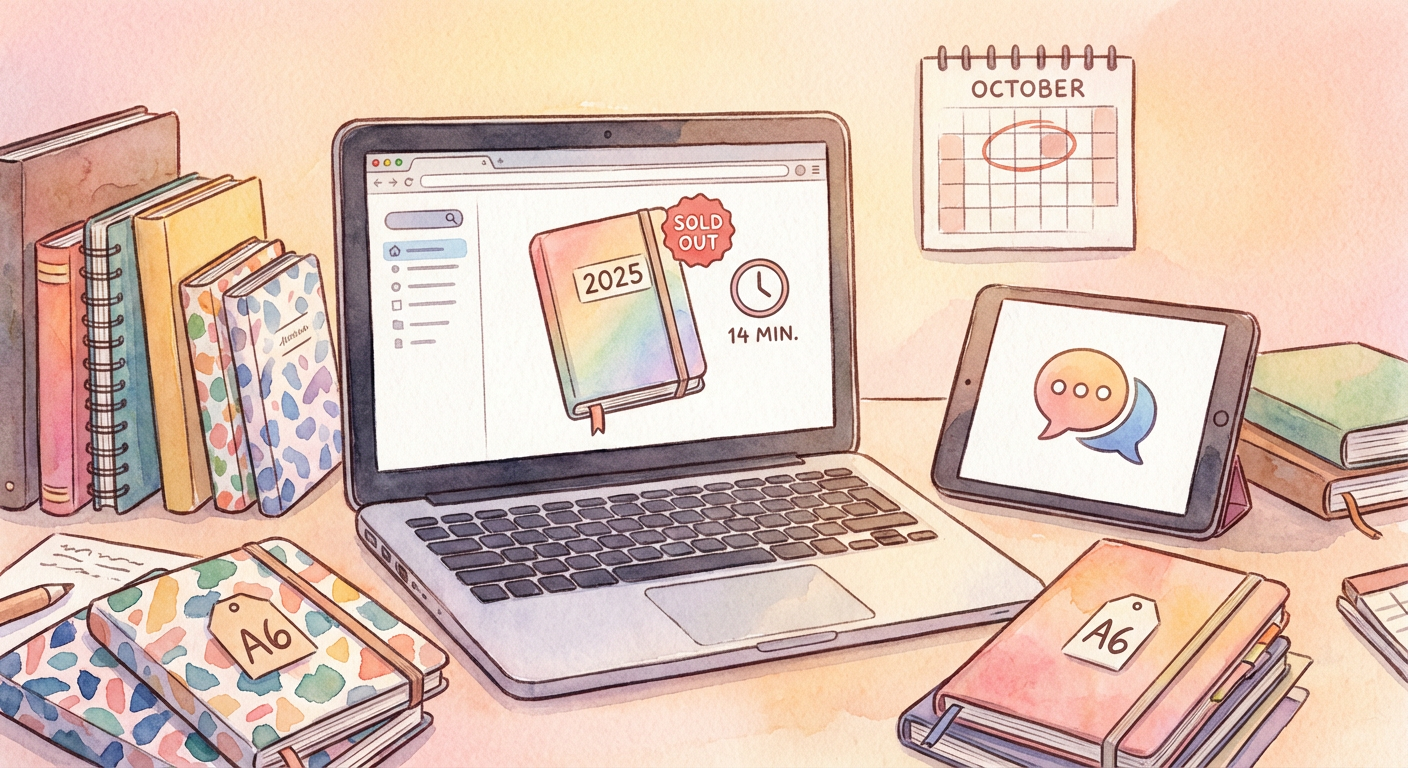
October 2024. A Thursday morning. Somewhere around 9 AM Japan Standard Time, the Hobonichi Techo Official Site opened orders for their 2025 A6 edition. By 9:14 AM, it was gone. Fourteen minutes. That’s less time than it takes most of us to finish our first coffee, and definitely less time than it takes to debate whether we actually need another planner. Over 82,000 people in the Hobonichi subreddit watched it happen in real time, refreshing obsessively, some getting through, most watching the dream evaporate.

This wasn’t a limited-edition designer collab or some rare vintage find being flipped on Depop. This was a notebook. A Japanese paper planner. A product that costs less than dinner for two at a decent restaurant. And it sold out faster than concert tickets.
We need to talk about what this means.
The Numbers Tell a Story About Exhaustion
Here’s what’s wild: the planner market is actually booming right now. Not in some niche, hobbyist way. We’re talking about an 11% year-over-year growth in global paper planner sales throughout 2024. Real market momentum. But the real story is in the premium segment, planners over forty dollars, which are growing at nearly double that rate. People aren’t just buying planners. They’re buying good ones. Investing in them.
Muji, the Japanese minimalist lifestyle brand, saw their North American stationery sales jump 27% in fiscal 2024. Their internal documents literally called it the ‘digital fatigue demographics aged 22-35’ effect. Let that sink in. A major retailer is now officially tracking and naming the phenomenon: young adults are exhausted by screens and actively buying their way out of it.
The #hobonichi hashtag on Instagram has crossed 2.3 million posts as of early 2025. The engagement isn’t coming from retired people or planning enthusiasts in their sixties. It’s coming from users in the U.S., Germany, and South Korea. Gen Z and younger millennials are the ones posting photos of their planners, sharing page layouts, documenting the tiny rituals of analog life.
Why Your Brain Prefers Pen to Keyboard
There’s actual neuroscience backing this up. A 2024 study from the University of Tokyo published in Frontiers in Behavioral Neuroscience found that handwriting activates significantly more areas of the brain than typing. The memory encoding alone is different. Your brain treats writing by hand as a fundamentally different activity. It’s not just that it feels better. Your neural pathways are genuinely more engaged.
Think about that for a second. We’ve spent the last fifteen years optimizing everything for speed and convenience. Apps that sync across devices. Cloud storage that remembers what you forgot. Notifications that ping you constantly so you never have to remember anything yourself. And now our brains are rebelling.
The Hobonichi Techo isn’t just a planner. It’s a permission slip. A deliberate choice to slow down a process that technology has been screaming at us to accelerate. When you sit down with a notebook and a pen, there’s no notification waiting. No algorithm suggesting what you should write next. Just you, paper, and the physical act of making marks that mean something.
The Loyalty That Can’t Be Downloaded
What gets me about the Hobonichi phenomenon is the loyalty. People don’t just buy this planner once. They buy it every year. There are people who have been using the same brand for a decade. They know the feel of the paper. They know how their favorite pens sit in the margins. They have routines around it, a real relationship with the object itself.
You can’t build that with an app. Apps update. They change their interface. They get discontinued. They sell your data. A notebook just sits there, exactly as it was the day you bought it, waiting for you to fill it with your actual life.
The fourteen-minute sellout wasn’t really about scarcity marketing or artificial demand. It was about millions of people simultaneously realizing they wanted the same thing. A break from the notifications. A way to remember things on their own terms. To write something down and have it stay written, not synced and backed up and monetized.
What We’re Actually Searching For
The Hobonichi selling out in fourteen minutes isn’t really about planners. It’s about control. So much of our attention is algorithmically managed now, so much of our memory outsourced to devices, our experience of time mediated by screens. A planner is the smallest possible rebellion. It’s you deciding how to organize your own day without anyone asking you to click an ad first.
The people rushing to buy this planner aren’t nostalgic for the pre-digital era. Most of them can’t even remember it. They want something specific: a tool that exists entirely for them, with no business model built on their attention, nothing that changes or updates or tries to upsell them. In a world where every product has become a platform for extraction, a notebook is almost radical in its simplicity.
So what does the fourteen-minute sellout actually tell us? That millions of people are ready to vote with their wallets for tools that give them back agency. That the brain science is real and people can feel it working. That there’s an entire generation discovering that sometimes the answer to information overload is the oldest technology humans have: paper and pen.
Have you noticed this shift in your own life? Are you reaching for analog tools more? What would your perfect planner look like if you could design it right now? Drop a comment or reach out. I’m genuinely curious where you’re landing on this.